
High-Efficiency Gas Cleaning with Controlled Liquid Use
Wet gas scrubbers are highly efficient gas cleaning systems capable of removing a broad spectrum of gaseous pollutants and, depending on design, particulate matter. However, the process requires substantial amounts of liquids, typically water. The gas is cooled adiabatically to its wet-bulb temperature, in accordance with the principles of adiabatic saturation and psychrometry (enthalpy balance), during which a portion of the liquid evaporates and may be emitted or carried over into the atmosphere.
Recirculation and Scrubbing Liquid Saturation
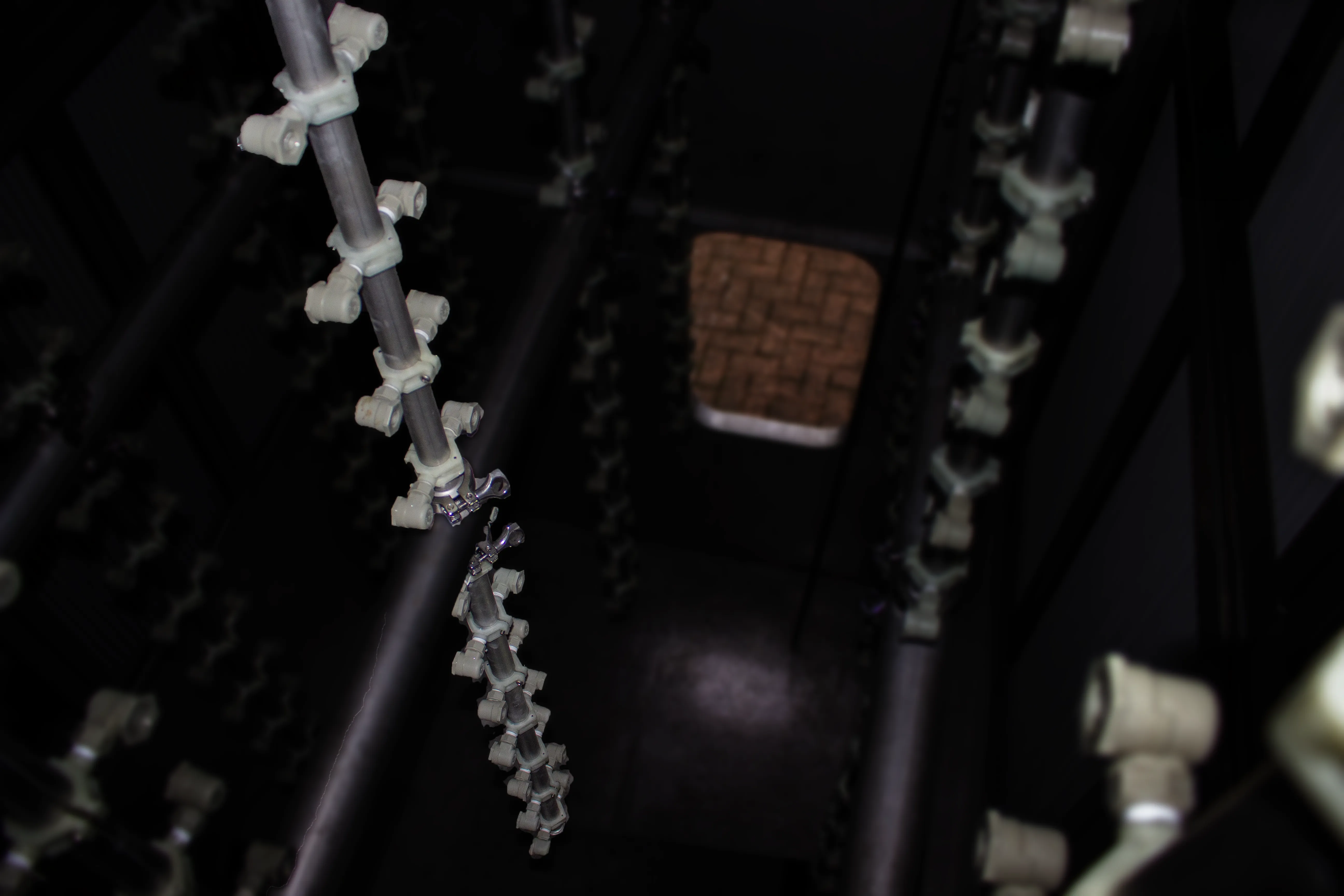 The scrubbing liquid is circulated repeatedly through the absorption column until it reaches saturation with the contaminants carried by the gas. This process is governed by mass transfer principles, including Fick’s laws of diffusion, which describe the transport of pollutants from the gas phase into the liquid phase. In certain applications, chemical additives are incorporated into the scrubbing liquid to accelerate or facilitate absorption through reactive mass transfer, following the kinetics of the relevant chemical reactions. The reacted chemicals and residual substances subsequently contaminate the scrubbing liquid, necessitating periodic replenishment to maintain consistent and effective gas removal.
Scrubbing Liquid Quality and Emission Performance
The quality of the emitted gas is directly dependent on the effectiveness of the absorption liquid. A strong correlation exists between the purity of the scrubbing liquid and that of the gas emissions; therefore, maintaining a refined absorption liquid ensures higher gas purity. The properties of the emitted gas are influenced by the characteristics of the scrubbing liquid, emphasizing the importance of continuous monitoring to maintain optimal thermodynamic and mass transfer conditions.
Purge and Automatic Replenishment
This operational regime involves periodically purging a portion of the scrubbing liquid while automatically replenishing it with fresh fluid. The purged liquid typically requires treatment prior to safe discharge into the sewage system, in accordance with laws of conservation of mass and environmental regulations.
Liquid Consumption Minimization Strategies
Ravebo, in collaboration with clients, implements strategies to minimize liquid consumption. Monitoring the composition of the exiting gas serves as a primary control parameter to ensure that no excess liquid is used. Additional optimization strategies include, for multi-stage scrubbers, countercurrent transfer of the scrubbing liquid from the final stage to the initial stage, filtration using a vacuum belt filter, clarification or decantation, and the application of duplex filters, selected according to particle size and chemical load. Countercurrent operation improves absorption efficiency in accordance with Le Chatelier’s principle, by maintaining a driving force for mass transfer throughout the stages.
External Cooling to Reduce Evaporation Losses
Where process conditions permit, external cooling of the scrubbing liquid may also be employed to reduce evaporation losses, consistent with thermodynamic principles governing vapor pressure and heat transfer.