
Operational Monitoring and Control Strategy
Overview of Monitoring and Control Functions
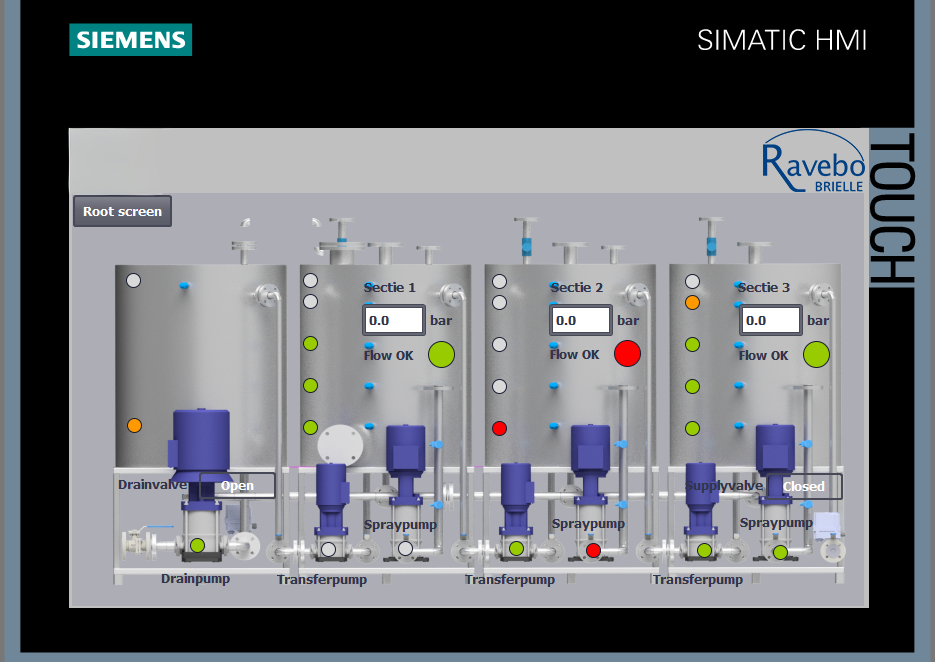
During operation of the wet gas scrubber system, a comprehensive monitoring and control strategy is implemented to ensure reliable performance, process stability, and equipment protection. The main control functions include pump monitoring, level control, and temperature monitoring, all of which are supervised by dedicated instrumentation and interlocks.
Pump Monitoring
The scrubber circulation pump is continuously monitored to verify correct hydraulic performance and to protect the system against abnormal operating conditions. A flow switch is installed to monitor the circulation flow. An increase in flow may indicate a worn or damaged spray nozzle, whereas a reduced flow typically indicates a restriction on the pump discharge side, such as fouling or partial blockage. If no flow is detected while the pump is running, the system will automatically stop the pump to prevent damage. The applicable flow limits and alarm thresholds are determined during commissioning. In addition, a pressure transmitter monitors the discharge pressure of the recirculation pump. Elevated pressure values can indicate nozzle clogging or downstream restrictions, while reduced pressure generally points to worn or broken nozzles. Pressure limits and setpoints are likewise established during commissioning to match the actual system characteristics.
Liquid Level Control and Safeguarding
Make-up and Drain Valve Interlocks
The liquid level in the scrubber basin is maintained slightly above the normal operating setpoint level switch. An electronic makeup valve is responsible for compensating water losses due to evaporation, draining, or other process-related losses, ensuring that the level remains above the minimum operating level at all times. To avoid conflicting control actions, the electronic makeup valve is interlocked and is not permitted to open while the electronic drain valve is active. The electronic drain valve is enabled when the conductivity sensor measures a value above its predefined setpoint, indicating excessive salt or contaminant concentration. Draining is only allowed provided that both the low-level switch and the flow switch of the circulation assembly are active. When the low-level switch is reached, the drain valve is forced closed to prevent excessive level reduction. Reopening of the drain valve is only permitted after the normal level setpoint has been restored and maintained for a predefined time period. In addition, the drain valve will open automatically if the high-level switch is activated, providing protection against overfilling. Similar to the makeup valve logic, the drain valve is interlocked and is not allowed to open while the makeup valve is open.
Level Switches and Pump Protection
For pump protection, a low-low level switch functions as a dry-run interlock for the scrubber pump, while a high-high level switch generates a high-level alarm to alert operators to abnormal conditions.
Temperature Monitoring and Thermal Control
Gas and Liquid Temperature Supervision
Temperature monitoring is implemented to track both gas and liquid thermal behavior within the scrubber. Temperature transmitters installed at the water basin monitor the incoming and outgoing gas temperatures, while temperature transmitters at the gas discharge section measure the corresponding incoming and outgoing water temperatures. This arrangement allows continuous supervision of heat transfer performance and provides early indication of process deviations or abnormal operating conditions.
Chemical Dosing and Water Quality Control
Automated pH and Free Chlorine Regulation
To ensure stable scrubber performance and consistent treatment efficiency, the system is equipped with automated chemical dosing controls for both pH and free chlorine concentration. These control loops are fully integrated with the liquid circulation and safety interlocks.
pH Control and Dosing Interlocks
The pH value of the washing water in the buffer tank is continuously measured by an online pH sensor. The measured value is maintained at the specified setpoint by means of a chemical dosing pump, which adds neutralizing agent as required. The pH setpoint is determined and optimized during commissioning to match the specific process conditions.
Dosing is only permitted when the flow switch of the liquid control assembly—housing the relevant sensors—is active, confirming adequate circulation flow. In addition, the dosing pump must be enabled by a release signal from the customer’s control system. If this release signal is absent, dosing is immediately stopped to prevent uncontrolled chemical addition.
Free Chlorine Control
The free chlorine concentration of the washing water in the buffer tank is monitored by an online free chlorine sensor. The measured chlorine concentration is regulated around a predefined setpoint using a dedicated dosing pump. As with the pH control loop, the chlorine setpoint is established during commissioning based on operational requirements and water chemistry.
Chemical dosing for free chlorine is only allowed when the flow switch of the liquid control assembly is active, ensuring correct sensor measurement conditions and sufficient mixing. The dosing pump operates exclusively when a valid dosing enable signal is received from the customer’s control system. In the absence of this signal, the dosing pump is automatically stopped.